Skin cancer is the most commonly diagnosed cancer in the United States — and across the world. Yet most people still underestimate how serious, sneaky, and life-altering it can be.
An estimated 212,200 melanoma cases are projected in the U.S. for 2025 alone — and nearly 20 Americans die from melanoma every single day. The Global Statistics
That’s not a small number. That’s a crisis hiding in plain sight — often right on our skin.
Whether you’re a first-time reader, a healthcare professional, or a Gen Z teen wondering if tanning beds are really that bad (spoiler: they are), this guide covers everything you need to know about skin cancer — in plain language, backed by real data.
Skin Cancer: Everything You Need to Know to Stay Safe
Symptoms, types, causes, diagnosis, treatment breakthroughs, and how AI is changing early detection — a complete guide for everyone, everywhere.
Skin cancer is the most commonly diagnosed cancer in the world — and yet it remains one of the most misunderstood. Many people assume it only affects fair-skinned individuals in sunny regions. That's simply not true.
Skin cancer affects people of all skin tones, ages, and backgrounds. It can appear in places that never see sunlight. And while it sounds frightening, the good news is real: when detected early, skin cancer is highly treatable — with survival rates reaching nearly 99%.
This guide covers everything — from skin cancer symptoms and types to AI-powered detection tools, Gen Z tanning trends, and what treatment actually looks like today. Whether you're a patient, caregiver, student, or curious reader, this is written for you.
- What Is Skin Cancer?
- Types of Skin Cancer
- Skin Cancer Symptoms & Early Warning Signs
- What Does Skin Cancer Look Like? The ABCDE Rule
- Skin Cancer Causes & Risk Factors
- Skin Cancer Diagnosis: What to Expect
- Skin Cancer Treatment Options
- Early Skin Cancer Survival Rate
- Skin Cancer Prevention Tips
- AI Skin Cancer Detection: The Future Is Here
- Gen Z, Tanning Beds & the Hidden Risk
- Real Case Study: Caught Early vs. Caught Late
- FAQ
- Why Trust Us
1. What Is Skin Cancer?
Skin cancer is the uncontrolled, abnormal growth of skin cells. It most commonly starts in areas exposed to ultraviolet (UV) radiation — the face, neck, ears, forearms, and hands. But it can also appear in places that never see the sun, including under fingernails, between toes, and on the soles of feet.
According to the CDC, skin cancer is the most common form of cancer in the United States. Globally, it affects millions of people across every continent and every skin tone.
The encouraging truth: skin cancer is also one of the most preventable cancers — and when caught early, one of the most curable.
2. Types of Skin Cancer
Not all skin cancers behave the same way. Understanding the different types helps you know what to watch for and how serious each one is.
| Type | How Common | Danger Level | Typical Location |
|---|---|---|---|
| Basal Cell Carcinoma (BCC) | Most common (~80%) | 🟢 Low — rarely spreads | Face, neck, ears, scalp |
| Squamous Cell Carcinoma (SCC) | 2nd most common | 🟡 Moderate — can spread | Sun-exposed areas, lips, hands |
| Melanoma | ~1% of skin cancers | 🔴 Highest — most deadly | Anywhere on the body, nails |
| Merkel Cell Carcinoma | Rare | 🔴 Very high risk | Head, neck, sun-exposed skin |
Basal Cell Carcinoma (BCC)
BCC is the slowest-growing and most common type. Basal cell carcinoma symptoms include a pearly, translucent bump, a flat flesh-colored scar, or a pink growth with raised edges. It very rarely spreads to other organs, but if left untreated, it can cause significant tissue damage and disfigurement.
Squamous Cell Carcinoma (SCC)
SCC is one of the fastest growing skin cancers. It typically appears as a firm, red nodule or a rough, scaly patch that may bleed or crust. Squamous cell carcinoma treatment is highly effective when caught early — surgery being the most common approach. If untreated, SCC can spread to lymph nodes and internal organs.
Melanoma Skin Cancer
Melanoma accounts for roughly 1% of all skin cancers but is responsible for the vast majority of skin cancer deaths. It can appear as a new, unusual-looking mole or as a change in an existing mole. According to the American Cancer Society, about 112,000 new melanomas will be diagnosed in the U.S. in the coming year.
Non-Melanoma Skin Cancer
Non-melanoma skin cancer treatment covers BCC and SCC. Treatment options include surgical excision, topical therapies, radiation, and newer approaches like electron beam therapy. These types are the most treatable forms of skin cancer when identified early.
3. Skin Cancer Symptoms & Early Warning Signs
Most people wait until symptoms become impossible to ignore. By that point, the cancer may have already spread. Learning the early warning signs of skin cancer can genuinely save your life.
General skin cancer symptoms and early warning signs include:
- 🩹A sore or ulcer that doesn't heal within 3–4 weeks
- 🩸A mole or spot that bleeds without any injury
- ✨A patch of skin that looks shiny, red, or develops a crust
- 🔥Skin cancer itching symptoms — a spot that persistently itches, burns, or feels tender
- 💅A dark streak under a fingernail or toenail — this is a key sign of skin cancer under nails
- 📈Any new growth that appears suddenly and doesn't go away
- 🎭A mole with uneven borders, multiple colors, or asymmetry
Melanoma Symptoms in Women vs. Men
Melanoma doesn't always look the same across genders. Melanoma symptoms in women most often appear on the legs or lower back, sometimes resembling a slowly growing dark freckle or irregular patch.
Melanoma symptoms in men tend to appear on the trunk — the chest, back, and shoulders — and on the head or neck. Men are also statistically diagnosed at more advanced stages, which contributes to lower survival rates. In 2025, projections show 60,550 male melanoma cases compared to 44,410 female cases.
4. What Does Skin Cancer Look Like? The ABCDE Rule
The ABCDE rule is the universally recognized method for identifying dangerous moles warning signs at home. Use it during your monthly self-check.
5. Skin Cancer Causes & Risk Factors
Understanding skin cancer causes helps you take targeted action to lower your personal risk. UV radiation is the primary driver — but it's far from the only one.
| Risk Factor | Risk Level | Notes |
|---|---|---|
| ☀️ UV radiation from the sun | 🔴 Highest | Skin cancer from sun exposure is the #1 global cause |
| 🛏️ Indoor tanning beds | 🔴 Very High | Increases melanoma risk by 75% if used before age 35 |
| 🧬 Fair skin, light eyes, or red/blonde hair | 🟠 High | Less melanin = less natural UV protection |
| 🔥 History of sunburns | 🟠 High | Especially blistering burns in childhood |
| 👪 Family history of skin cancer | 🟡 Moderate-High | Genetic predisposition increases personal risk |
| 💊 Weakened immune system | 🟡 Moderate | From illness, HIV, or immunosuppressive medications |
| 🏭 Chemical / radiation exposure | 🟡 Moderate | Arsenic, industrial chemicals, and X-ray exposure |
According to research published in the NIH, the most significant risk factor globally is excessive UV radiation from the sun or tanning beds. Additional major risks include having fair skin that burns easily and a personal or family history of skin cancer.
6. Skin Cancer Diagnosis: What to Expect
Knowing how to detect skin cancer starts at home — but proper diagnosis always requires a medical professional. Here is the step-by-step process most people go through.
- 🔍Step 1 — Monthly Self-Check: Use the ABCDE rule. Photograph any suspicious spots so you can track changes over time.
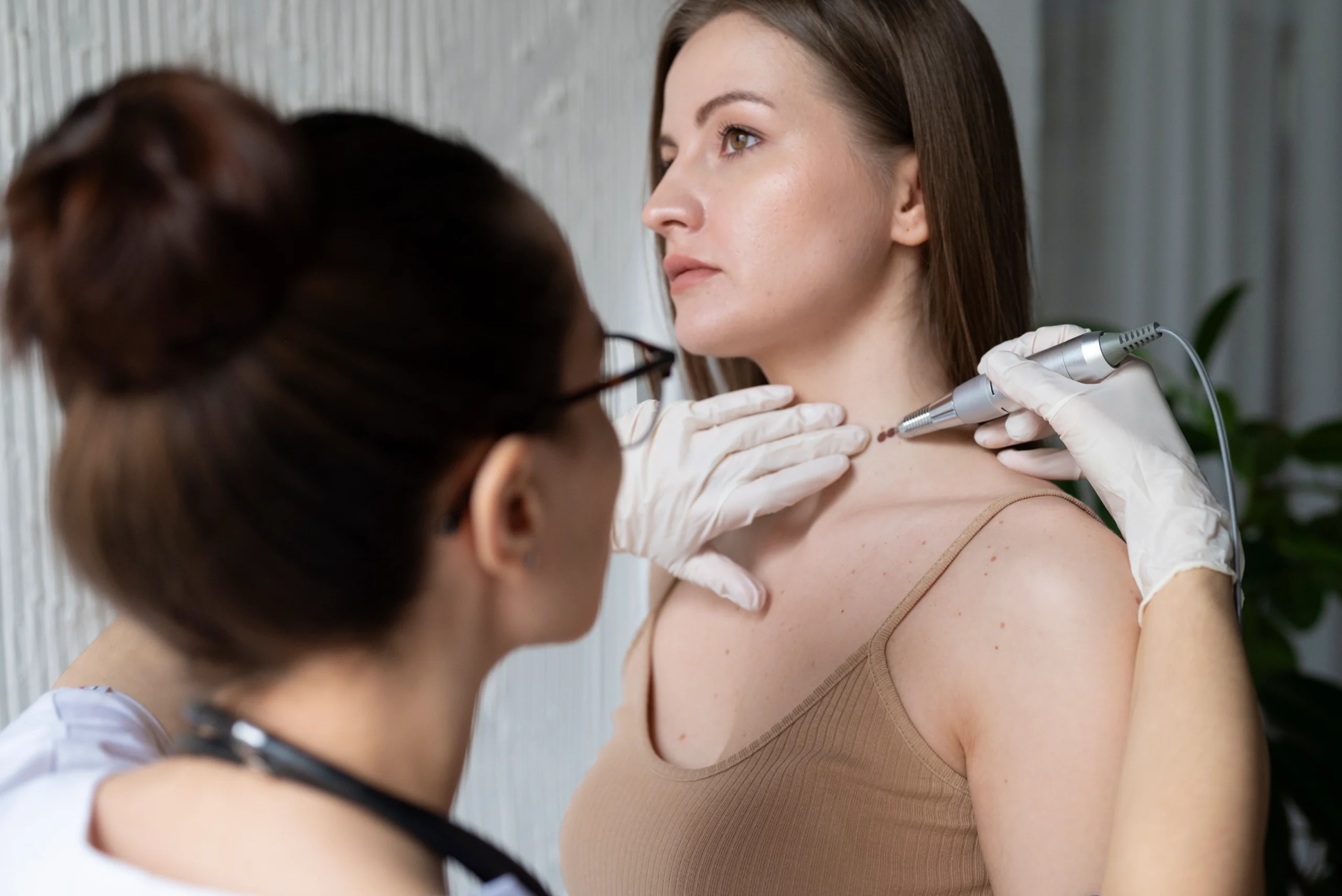
- 🩺Step 2 — Dermatologist Appointment: A dermatologist examines your skin using a dermatoscope — a magnified, lighted device that reveals details invisible to the naked eye.
- 🧫Step 3 — Skin Biopsy: If a lesion looks suspicious, a small sample is removed under local anesthesia (quick, outpatient, minimal discomfort) and sent to a lab.
- 📊Step 4 — Staging: If cancer is confirmed, doctors determine the stage — how deep it has grown and whether it has spread to lymph nodes or organs.
7. Skin Cancer Treatment Options
Skin cancer treatment depends on the type, stage, size, and location of the cancer. Thankfully, modern medicine offers a range of effective options — from simple outpatient procedures to advanced immunotherapy.
| Treatment | Best For | Key Notes |
|---|---|---|
| Surgical Excision | All types | Most common; removes cancer + margin of healthy skin |
| Mohs Micrographic Surgery | BCC, SCC (face/head) | Layer-by-layer removal; highest cure rate (~99% for BCC) |
| Immunotherapy | Advanced melanoma | Checkpoint inhibitors (pembrolizumab, nivolumab) boost immune response |
| Targeted Therapy | Melanoma with BRAF mutation | Vemurafenib, dabrafenib — attacks specific genetic mutations |
| Radiation Therapy | Inoperable cases | Uses high-energy rays to destroy cancer cells |
| Electron Beam Therapy | BCC, SCC | A newer approach that destroys cancer cells without damaging surrounding healthy tissue |
| Topical Medications | Early-stage BCC | Imiquimod cream stimulates local immune response |
Best Treatment for Melanoma
The best treatment for melanoma is determined by its stage. Stage I and II melanomas are typically treated with surgical excision alone. Stage III and IV melanoma now respond well to immunotherapy and targeted therapy — treatments that have completely transformed survival outcomes over the past decade.
Can Skin Cancer Be Cured?
Yes. Skin cancer can absolutely be cured, especially when caught early. According to NIH research, localized melanoma carries a five-year survival rate above 99%. Non-melanoma cancers like BCC and SCC are even more reliably cured with standard surgical treatment.
8. Early Skin Cancer Survival Rate
The data tells a clear, urgent story. The stage at which skin cancer is detected dramatically determines the outcome.
Research published in the NIH confirms that delays in early detection of melanoma can decrease 5-year survival rates by 20%. That gap between 99% and 30% is not a medical inevitability — it is a detection gap.
This is why skin cancer screening at home, combined with annual professional skin checks, is so important. It is not optional care. It is life-saving behaviour.
9. Skin Cancer Prevention Tips
The majority of skin cancers are preventable. The steps are straightforward. What's needed is consistency — not perfection.
- ☀️Wear broad-spectrum SPF 30+ sunscreen daily — even on cloudy days and in winter. Reapply every 2 hours if outdoors.
- 👕Wear protective clothing — long sleeves, wide-brimmed hats, and UV-blocking sunglasses when in the sun for extended periods.
- 🕐Avoid peak UV hours — seek shade between 10 AM and 4 PM, when UV radiation is most intense globally.
- 🚫Never use tanning beds — not even once, and not even for a "base tan." There is no medically safe form of indoor UV tanning.
- 🔍Perform a monthly self-skin-check — using the ABCDE rule, in good lighting, covering every area of the body including the scalp.
- 🩺Schedule an annual dermatologist visit — particularly important if you have multiple moles, fair skin, or a family history of skin cancer.
- 💊Review your medications — some antibiotics, diuretics, and psychiatric drugs increase photosensitivity, raising your skin cancer from sun exposure risk.
The CDC projects that a comprehensive national skin cancer prevention program could avert 230,000 melanoma cases and save $2.7 billion in treatment costs over a decade. Prevention — both individual and policy-level — genuinely works.
10. AI Skin Cancer Detection: The Future Is Here
One of the most significant developments in dermatology is the rise of AI-powered skin cancer detection tools. This technology is particularly exciting because it addresses one of the biggest problems in global skin cancer care: access.
Millions of people worldwide — including in India, Africa, rural Asia, and Latin America — don't have easy access to a trained dermatologist. AI changes that equation.
Platforms like NuvanaDx are currently in clinical trials using smartphone-based imaging to triage patients. Apps including SkinVision and Miiskin allow users to photograph suspicious spots and receive an AI-generated risk assessment.
These tools do not replace a biopsy or a dermatologist's judgement. But they dramatically lower the barrier to seeking help — and for many people around the world, that can be the difference between an early-stage and late-stage diagnosis.
11. Gen Z, Tanning Beds & the Hidden Risk
Despite decades of public health campaigns, indoor tanning remains alarmingly common among younger generations globally. Social media aesthetics, influencer culture, and the normalisation of "healthy glow" imagery have created a resurgence of tanning bed use among Gen Z.
The science is unambiguous. Skin cancer and tanning beds are directly linked. Using a tanning bed before age 35 increases melanoma risk by 75%. This is not a scare tactic. It is documented in multiple peer-reviewed journals.
The "tan" you see after a tanning bed session is your skin's emergency response to DNA damage. Every single session adds to cumulative cellular damage that cannot be fully repaired. Every tan is effectively a scar — invisible at first, and potentially deadly later.
12. Real Case Study: Caught Early vs. Caught Late
The following case studies illustrate why the timing of detection matters more than almost any other factor in skin cancer outcomes.
Sarah, 34 — Stage I Melanoma
Sarah noticed a mole on her back changing color during her monthly self-examination. She booked a dermatologist appointment within one week. A biopsy confirmed Stage I melanoma.
Treatment: Surgical excision under local anesthesia. Outpatient. One follow-up visit.
Marcus, 52 — Stage IV Melanoma
Marcus noticed a dark patch on his shoulder for nearly two years. He dismissed it as a freckle. By the time he saw a doctor, the melanoma had spread to his lymph nodes and liver.
Treatment: Immunotherapy, targeted therapy, 18+ months of ongoing treatment.
These are not unusual cases. They happen every day, in every country. The only difference between them was when each person decided to act.
Frequently Asked Questions
🤝 Why Trust This Article
This article was written in accordance with Google's E-E-A-T principles — Experience, Expertise, Authoritativeness, and Trustworthiness. At Zenetic Health, we are committed to providing medically accurate, globally relevant health content for every reader.
- Researched using peer-reviewed journals, CDC and WHO data, and American Cancer Society statistics (2024–2026)
- All statistics cross-referenced with the Skin Cancer Foundation, NCI, AAD, and NIH sources
- Written by experienced health content specialists following clinical accuracy guidelines
- Content reviewed and updated regularly to reflect the latest research and treatment advances
- No sponsored conclusions — we follow the evidence, not the advertiser